







From Building My Own Timber House to Guiding Self-Renovation Projects
Discovering Self-Build Construction
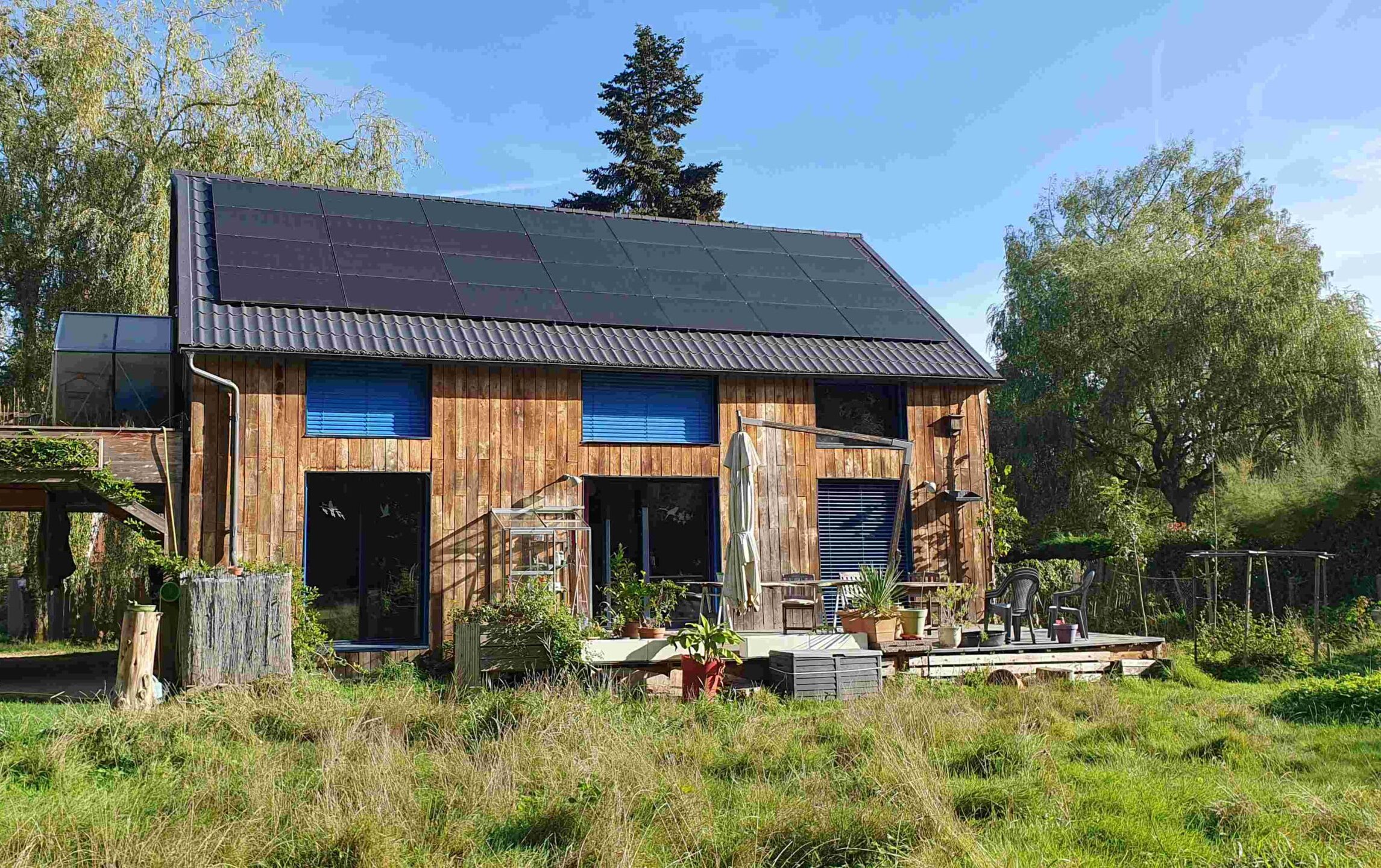
My name is Florence Allièse. In 2016, my partner and I began dreaming of building a house with very low heating needs and therefore a minimal environmental impact. We immersed ourselves in learning about construction methods, insulation, heating systems and ventilation. Nearly two years later, we started the guided self-build of a timber house in the Chevreuse Valley. Balancing the project with my job as an animal caretaker in a rescue shelter was challenging, but it introduced me to a whole new world and a vibrant community centred around eco-friendly self-building and self-renovation.

Training in Eco-Construction
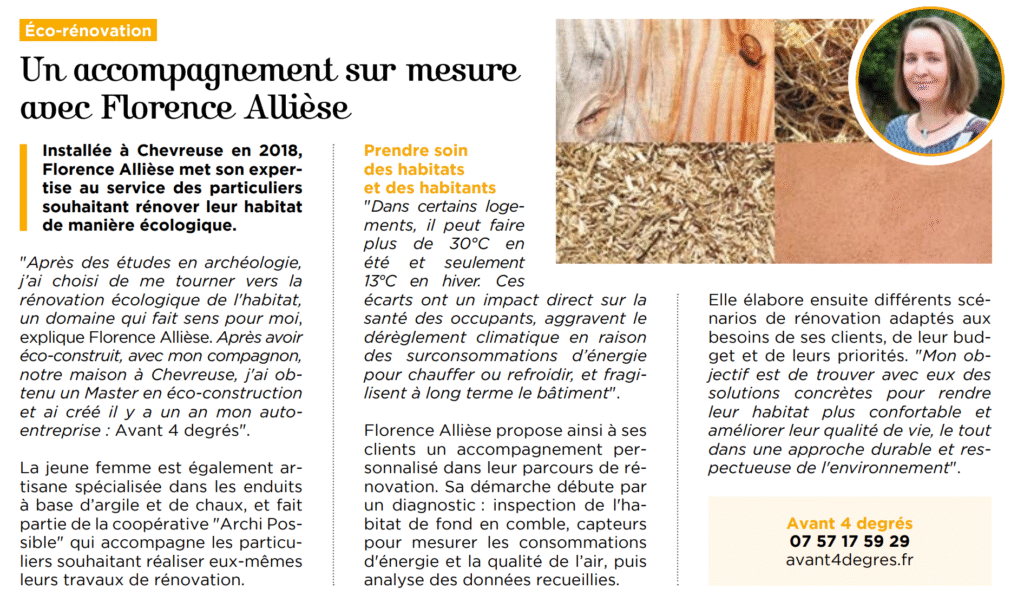
In 2022, I decided to leave the animal welfare sector and dedicate myself fully to eco-renovation and sustainable building practices. After gaining hands-on experience on various projects, including timber construction, lime-sand and hemp-lime plasters, and clay-straw insulation, I began a Master’s degree in Eco-Construction. This programme allowed me to deepen my knowledge of building physics, acoustics, eco-materials, planning regulations and construction economics. It also gave me the opportunity to discover the inner workings of a France Rénov' advice centre, France's public home renovation service, during my apprenticeship with Énergies Solidaires in northern Yvelines. My dissertation, which focused on the motivations and barriers to the use of eco-materials among homeowners and building professionals, highlighted a significant lack of knowledge about these materials despite their growing popularity.
Training in Eco-Construction
In 2022, I decided to leave the animal welfare sector and dedicate myself fully to eco-renovation and sustainable building practices. After gaining hands-on experience on various projects, including timber construction, lime-sand and hemp-lime plasters, and clay-straw insulation, I began a Master’s degree in Eco-Construction. This programme allowed me to deepen my knowledge of building physics, acoustics, eco-materials, planning regulations and construction economics. It also gave me the opportunity to discover the inner workings of a France Rénov' advice centre, France's public home renovation service, during my apprenticeship with Énergies Solidaires in northern Yvelines. My dissertation, which focused on the motivations and barriers to the use of eco-materials among homeowners and building professionals, highlighted a significant lack of knowledge about these materials despite their growing popularity.
Back on Site!
While this Master's degree provided me with a solid theoretical foundation, one essential element was still missing: hands-on experience! Discovering clay plasters during a supervised project led by Aurélie Massé from Matières Vivantes was a real turning point. Inspired by this experience, I trained in clay plasters with Noria Formation and in lime plasters at the European School of Material Arts. I also completed Rémy Chorda's hemp-lime construction course at the National Hemp School.
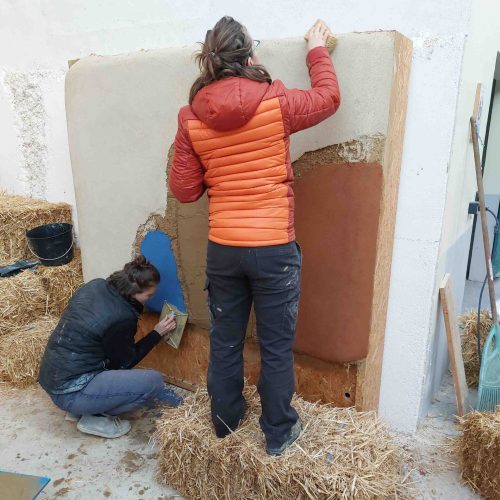
Application of clay plasters to a straw bale model for the materials library of the French Vexin Regional Natural Park, as part of a project supervised by Aurélie Massé (Photo credit: French Vexin Regional Natural Park).
Building or Renovating Your Home Yourself Is Archi Possible!
Self-building and self-renovation involve carrying out all or part of a construction or renovation project yourself. Far from being a marginal practice, 29% of the renovation measures recorded in the TRÉMI survey, jointly conducted by ADEME and published in 2022, were carried out as self-renovation projects, including 3% with professional support. Introduced in 2015 by the ANAH, the Assisted Self-Renovation scheme (ARA) enables homeowners to carry out their own renovation work, whether energy-related or not, with methodological and technical guidance from a professional. Initially aimed at households experiencing energy poverty, ARA has evolved over time and now takes different forms depending on the practices of its 600 operators.
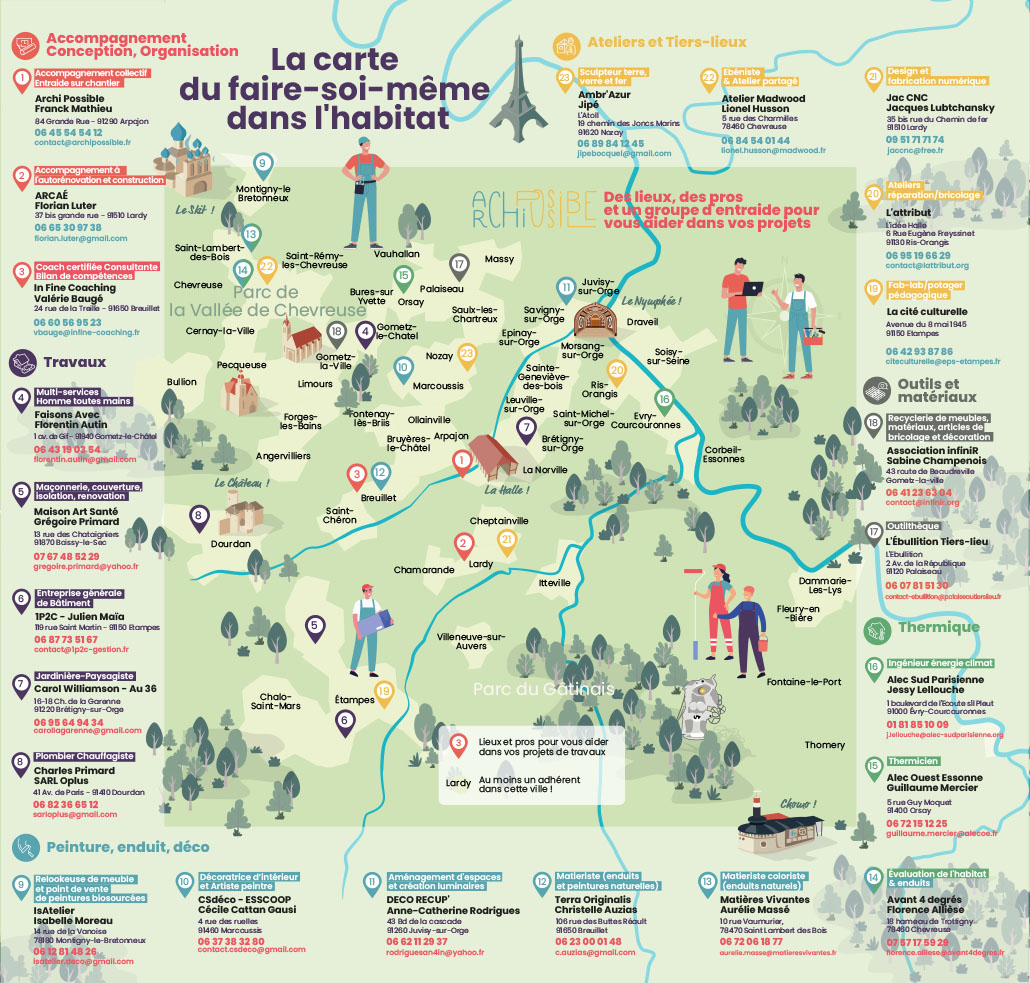
Self-building and self-renovation offer an answer to two major obstacles for homeowners: affordability and the lack of available tradespeople. Thanks to Jean-Michel Pinon and his company Homelib, we were able to invest the labour savings in high-quality materials while still benefiting from professional expertise and ten-year structural warranty coverage. Today, I am part of the Archi Possible cooperative, founded by Franck Mathieu, which supports self-builders and self-renovators in the Yvelines and Essonne regions through a network of homeowners and professionals.